Moving Chairs
Or: what happens when you stop shouting and rearrange the furniture

This cursed attention economy has ruined political debate. The loudest voices in the room get rewarded financially and have their egos buffed. Algorithms optimise for outrage, platforms monetise polarisation and the result is a public conversation that produces more heat than light. Louder slogans. Angrier tweets. Bigger lies. As the inevitable WB Yeats truism has it: “The best lack all conviction, while the worst/ Are full of passionate intensity”.
The thing is I've spent the best part of twenty-three years testing the opposite theory: that what most people actually want is not to be preached or pandered to, but to be invited to consider and contribute. And, maybe, to have a laugh while they're doing it: the spoonful of sugar that helps the medicine go down. This is harder than it sounds and pays quite as badly as you'd imagine.
My name is Naoise Nunn. I’m a festival maker based in Kilkenny and this is a newsletter about what I’ve taken to calling social architecture — the art of designing encounters between people so that something significant happens that might not otherwise without those interventions. I’ve been practising it since 2003, when a thing called the Leviathan first appeared in an underground club in Dublin that smelled of the ancient sewers beneath.
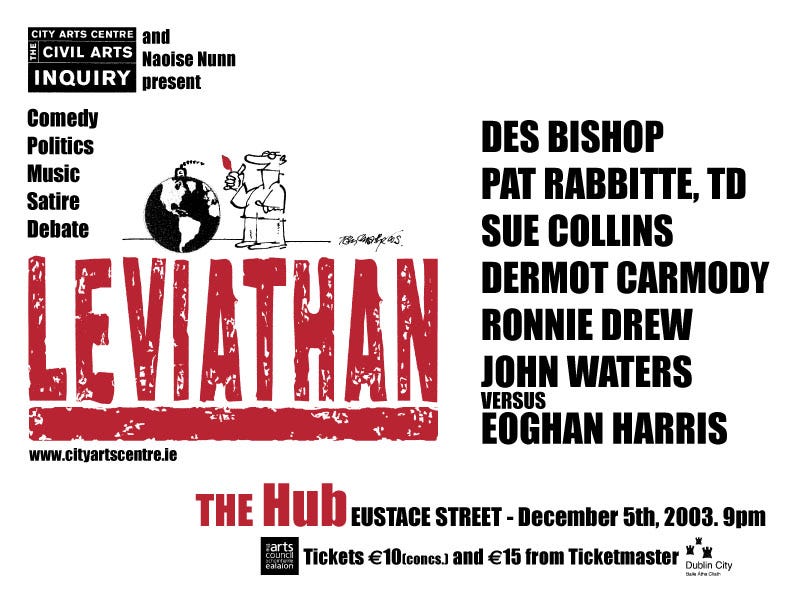
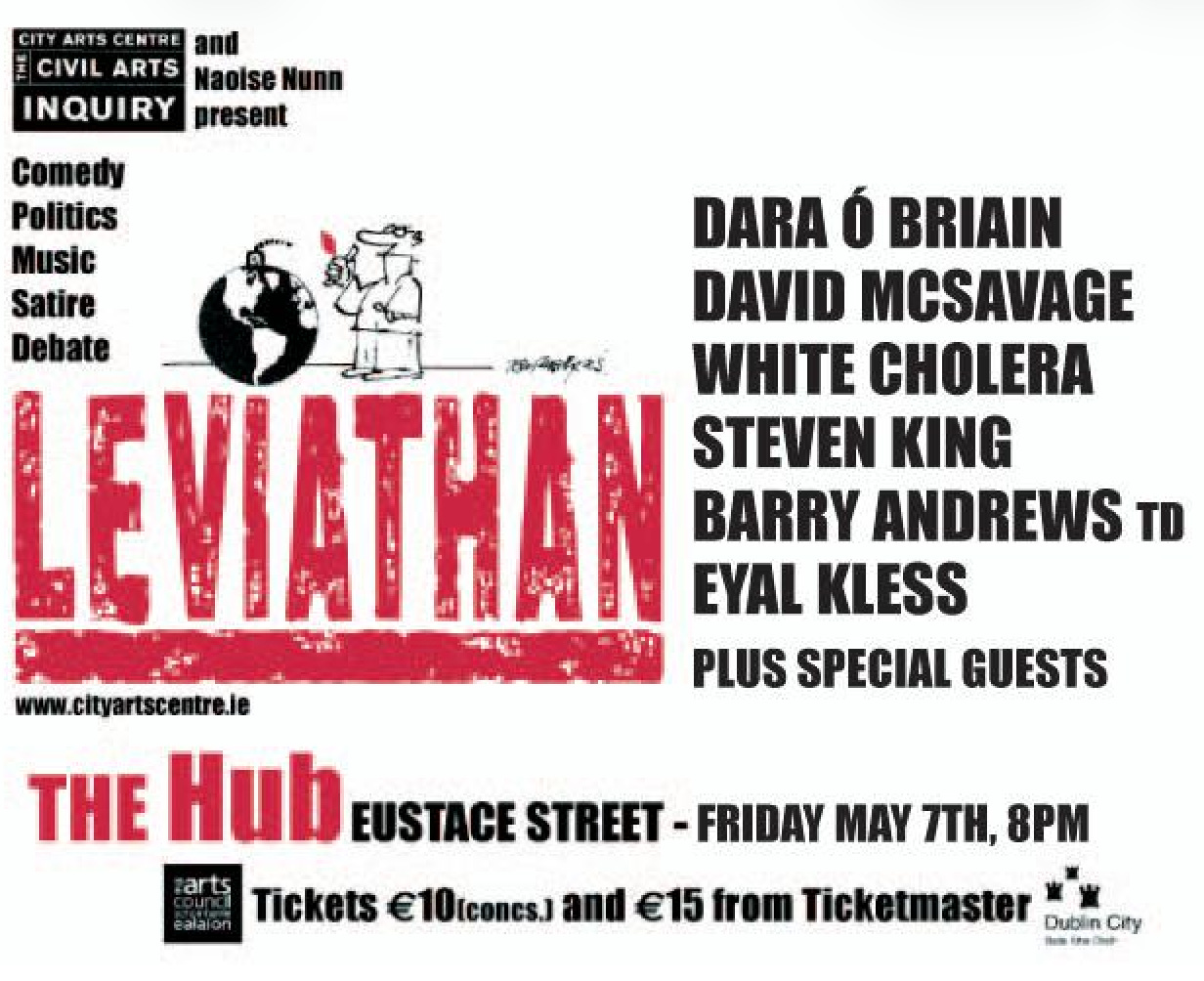
It soon moved to Crawdaddy - the late great John Reynolds’ cavernous venue - almost always helmed by my great friend and collaborator, David McWilliams appearing as, simultaneously, referee and provocateur. Paddy Cullivan contributed musical satire and there were animated films, political punk and spirited exchanges of ideas. And yes, there were far too few women back then, to my enduring embarrassment.
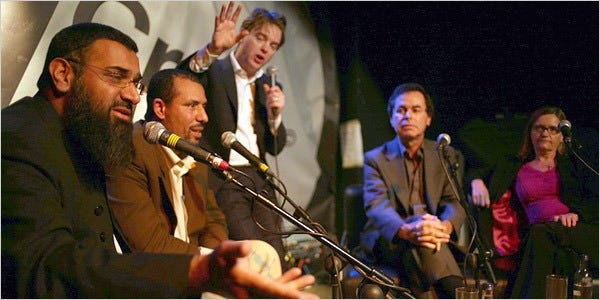
My bio says that I create, programme and produce festivals and events and that’s true. But when I’m asked what exactly that entails, I usually say: “well, fundamentally… moving chairs”.
I mean this both literally and figuratively. Who sits where; who speaks first; the distance between the speakers; the distance between stage and audience; chairs, stools or sofas — every one of these decisions weighs questions of power and attention but appears like mere logistics. I learned much about this in various roles in politics inside and outside Leinster House: how the physical arrangement of people in chairs and at tables are expressions of power that govern access to - and exclusion from - participation. I didn’t think of it then as training for the world in which I now live, but it was.
Since then I’ve founded MindField - now in its 20th year - with six stages of non-music programming attracting about twenty thousand visitors in the middle of Electric Picnic, Ireland’s biggest music and arts festival. I’ve been co-director with David McWilliams of Kilkenomics, the world’s first and biggest festival of economics and comedy; and artistic director of the Cat Laughs Comedy Festival - Ireland’s first. I’m the co-founder of Kilkenny Law Festival and Kilkenny Animated; and co-creator of Design Kenmare, the country’s first place-based design festival. Each of these projects was, fundamentally, the same experiment: what happens when you push seemingly unconnected people out of their comfort zone and into a contained space with some charm and humour and then invite an audience in to participate?
MindField at Electric Picnic 2025. Rafal Kostrzewa, Richard Walshe and Jude Moran Nunn.
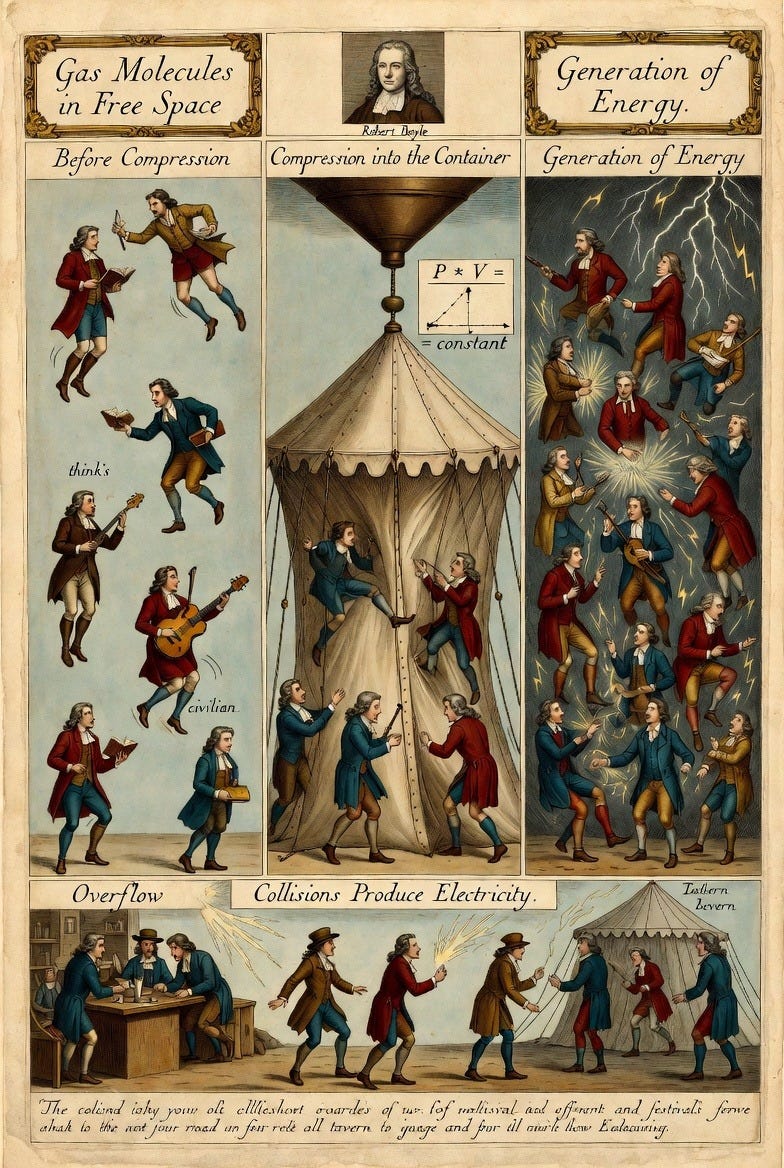
I’ve sometimes thought about this in terms of Boyle’s Law, brought to us by Robert Boyle - of Lismore Castle - who also gave us modern chemistry. He said that if you compress a gas into a smaller volume, the molecules collide more often and more forcefully, generating energy. That’s producing. You take thinkers, performers, jokers, troublemakers and civilians and you push them into a tent, a field, a comedy club, a town or city for a weekend. If you’ve chosen the right molecules and the right sized container, they don’t just collide. They generate electricity. The profound conversations in the bar after the panel. The friendly arguments between strangers in a queue. That’s energy you can’t manufacture, but it is energy that you can make inevitable.
---
I’m starting this newsletter for a few reasons.
First, because I’ve noticed that much of the public conversation about ideas, politics, and culture has become almost unbearably short-sighted and facile. Not because people are stupid — they’re not — but because the various formats and algorithms assume they are. The talk radio shouting match. The simplistic click-bait hot take. The four-thousand-word Substack from someone who just discovered Manufacturing Consent by Chomsky and Herman and wants to you to know that they know it explains everything. The assumption baked into so much is that citizens are either too angry or too dim to engage with complexity and that they don’t have any personal agency. I don’t believe that. Every festival or event I’ve ever made is built on the opposite assumption: that most people will reach for the highest common denominator if you give them half a chance, a little patience, some respect and, ideally, a couple of drinks.
Second, because I’ve spent two decades designing rooms where people think and converse together and I’ve learned a few things about what makes that work and what kills it. Some of these lessons are about festivals and individual events. Some are about politics. Some are about the particular Irish talent for putting serious people in unserious circumstances and seeing what the fuck happens.
Third, because the producer is often the most invisible person in any creative enterprise. The performer gets the applause. The venue gets the gig. But the social architecture that underpins the whole encounter is just silently humming in the background. This is not necessarily a complaint on my part — just a small attempt to explain the thinking behind the moving of the chairs and why it’s so important.
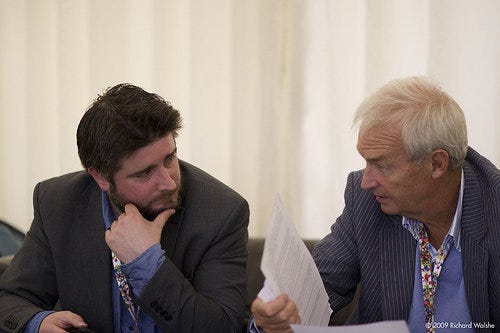
What you can expect here: short, occasional pieces about festivals, politics, ideas, Ireland and the business of getting people into rooms together. Some of it will be about specific projects — MindField, a new iteration of Leviathan we’re building for a boat on the Thames beside Westminster, the strange joys of producing festivals of law and animation in Kilkenny and the extraordinary creative community that brings world class design conversations to Kenmare . Some of it will be about the broader question of how democracies talk to themselves when the old formats are dying and the new ones are yet to be tested…or conceived of.
I believe in institutions, though not uncritically. I’ve little time for anyone who thinks the answer to institutional failure is to burn the institutions down rather than fix them. I’m suspicious of the radical chic that adopts political positions and causes as a performative personal brand. I have no time at all for populists who cynically flatter electorates by appealing to their lowest common denominator and basest instincts. I think the hardest and most important thing in public life is getting people to sit in a room in the company of those with whom they disagree to talk it all out and stay until there’s some common ground. And maybe sing a song together at the end of it all. That’s what my festivals try to do. That’s what I’ll try to do here.
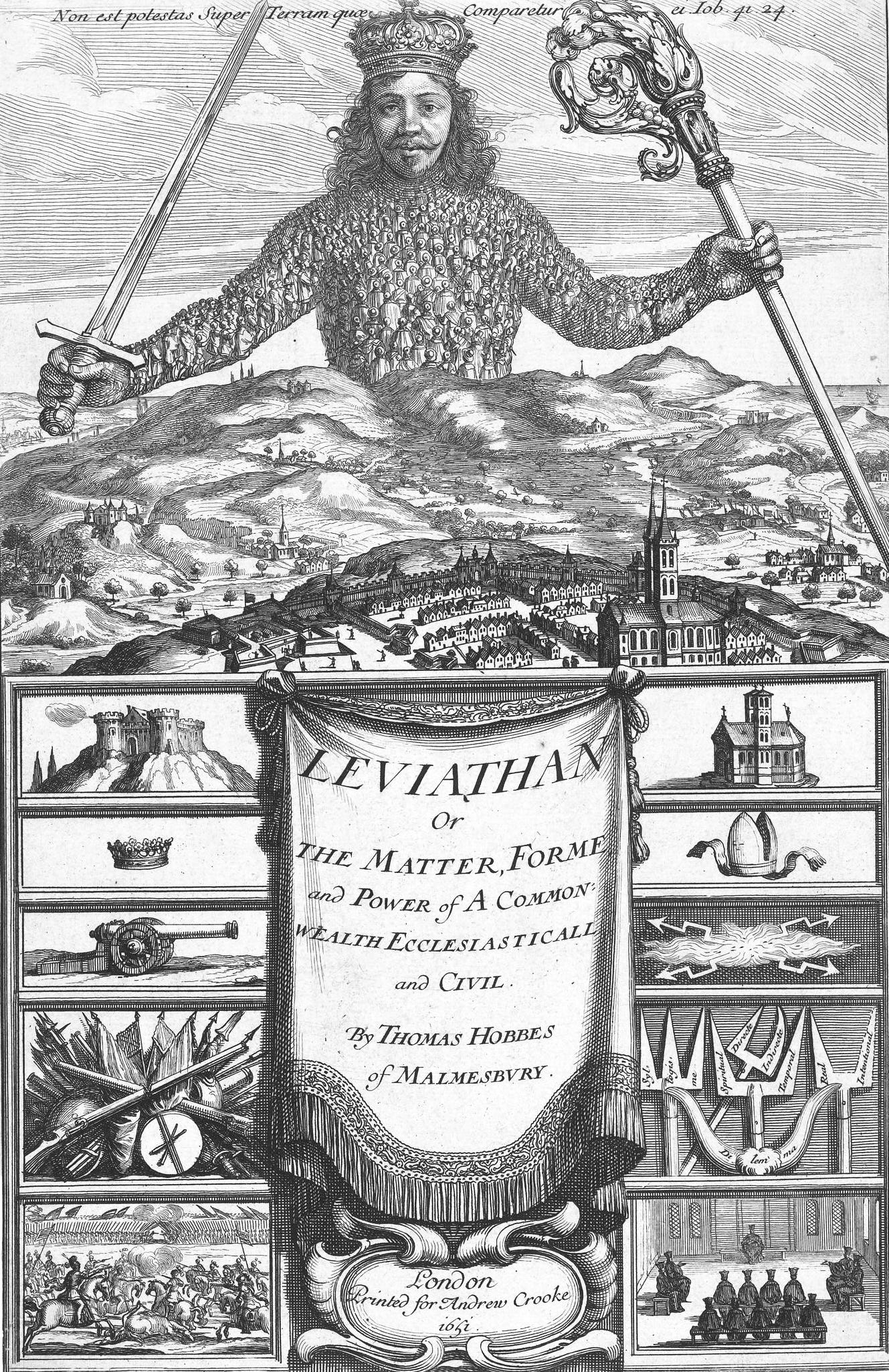
The political philosopher Thomas Hobbes called his masterwork Leviathan — a vision of the great political body made up of all of us, each small figure composing something larger than any individual. I borrowed the name for a political cabaret event in a dank basement twenty-three years ago, and I’ve been moving chairs in its honour ever since.
Pull one up and join me for a pint.
---
Naoise Nunn is the founder of Leviathan: Political Cabaret; MindField at Electric Picnic; co-founder of Kilkenny Animated and Kilkenny Law Festival; former co-director of Kilkenomics, former artistic director of the Cat Laughs Comedy Festival; and co-director of festival makers Schweppe Curtis Nunn. He lives in Kilkenny, where he is, usually, moving chairs.
Good luck! Looking forward to reading your dispatches as we attempt to circumnavigate the globe on our bicycles. The view of America from a bicycle at the moment is interesting, to say the least.
That’s really interesting. I organise events in the North East of England- music exclusively these days but I have done political stuff in the past. I appreciated the sentence where you say ‘the social architecture that underpins the whole encounter is just silently humming in the background.’
That’s exactly what I do - hum along in the background, silently hoping and praying that people buy tickets.